To address these diverse research topics, we flexibly combine theoretical, observational, experimental, and instrumental approaches.
Research Topics
Co-evolution of planets and life, and search for life in the universe: from the Solar System to exoplanets.
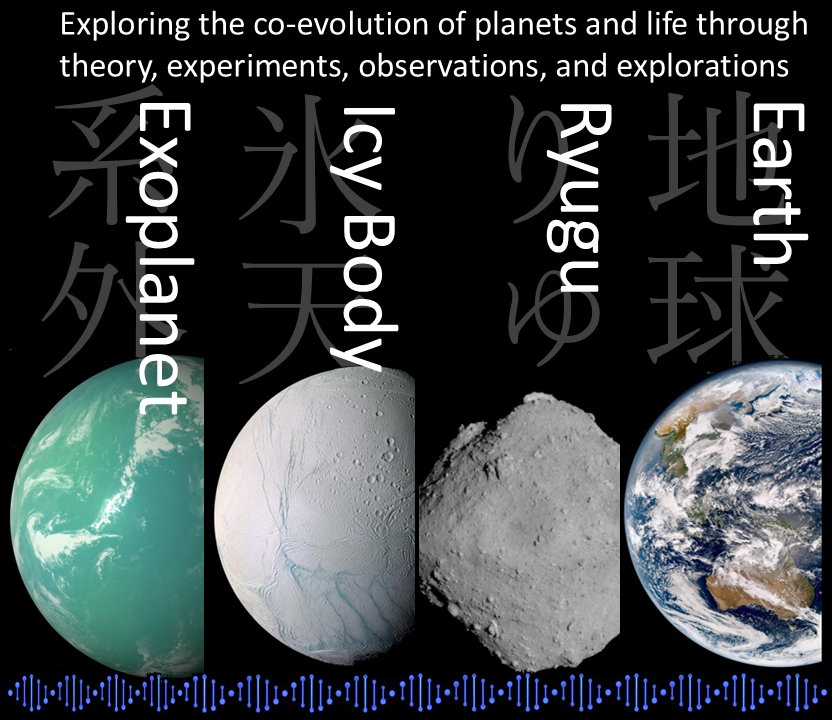 Since the discovery of the first planet outside the Solar System in 1995, more than 6,000 exoplanets have been identified. Many of these are small, Earth-sized planets, and some are thought to be capable of sustaining liquid water on their surfaces. Within the Solar System, liquid water is known to have existed on ancient Mars, and subsurface oceans are expected in icy bodies such as Europa in the Jovian system, Enceladus in the Saturnian system, and Pluto.
Despite these promising environments, investigating biological activity beyond Earth remains extremely challenging. One major difficulty lies in observing faint, Earth-like planets orbiting bright Sun-like stars, as well as in directly detecting life during planetary exploration, where biological activity—if present—may be highly localized. Another challenge is that exoplanets are typically observed as unresolved point sources, which severely limits the amount of information that can be obtained.
To date, efforts to detect biological activity have focused on inferring atmospheric gas compositions from absorption features in reflected visible light and thermal infrared emission. From the perspective of the coevolution of Earth and life, our research aims to develop indicators of biological activity by considering how life has reshaped Earth’s surface on a global scale (see Section 1). In addition, for bodies within the Solar System, we assess their potential habitability by drawing on knowledge of terrestrial life, while first clarifying the origin and evolutionary history of each object (see Section 2).
To address the associated observational and technical challenges, we are also involved in the development and operation of advanced instruments and space missions. These include coronagraphs that suppress the light of bright host stars, the formation-flying space interferometer SEIRIOS, which enables high spatial resolution, the Jupiter system explorer JUICE, and the ultraviolet space telescope LAPYUTA. Together, these efforts aim to deepen our understanding of planetary environments and their potential to host life (see Section 3).
1. Co-evolution of Earth and life
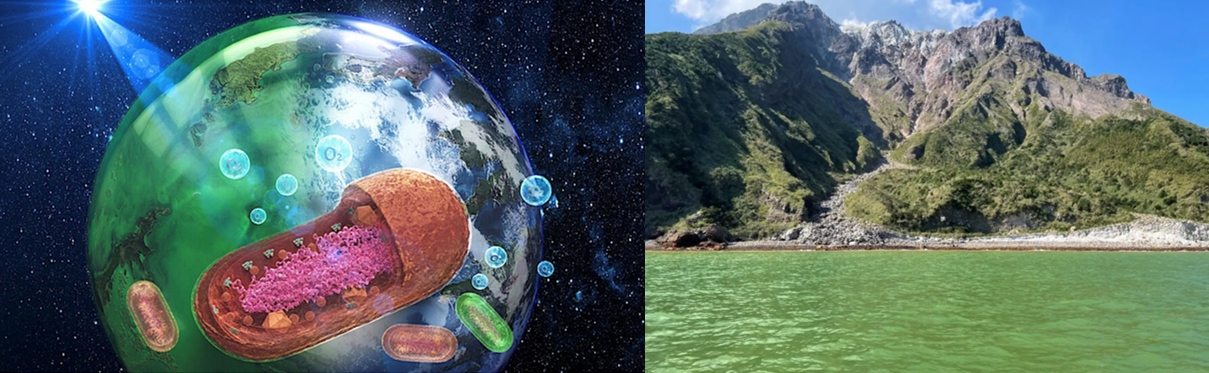 Since the emergence of life on Earth about four billion years ago, the planet has undergone major environmental changes through continuous interaction with biological evolution. For example, the Great Oxidation Event around 2.4 billion years ago facilitated the emergence of eukaryotes and subsequently led to the evolution of multicellular animals, while further transforming the Earth’s environment. This perspective of the coevolution of Earth (planetary bodies) and life not only deepens our fundamental understanding of life itself, but also provides an important framework for examining the potential for life throughout the universe, from within the Solar System to exoplanetary systems. Based on this viewpoint, we conduct experimental and theoretical studies on the origin and evolution of oxygenic photosynthetic organisms, the linkage between environmental variations associated with celestial motions and biological evolution, and the development of indicators for the presence of life on exoplanets.
2. Origin and evolution of planetary bodies
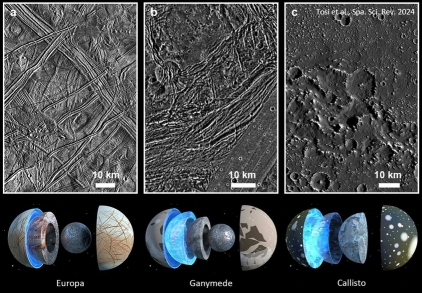 The evolution of life on Earth and the possible emergence of life on extraterrestrial bodies are inseparably linked to the formation and evolution of the bodies themselves. The Solar System contains a wide variety of objects, ranging from small bodies such as the asteroid Ryugu, to icy worlds like Europa and Enceladus, and to planets such as Mars, Jupiter, and Saturn. These bodies exhibit extremely diverse characteristics in terms of size and composition, surface morphology and internal structure, and the presence or absence of atmospheres. Explaining why such diversity arose is one of the major goals of planetary science, and an understanding of this diversity is essential for assessing the potential for the emergence of life. To elucidate the evolutionary processes by which planetesimals in the primordial Solar System grew through repeated aggregation and fragmentation, forming (or not forming) various internal and surface structures, we construct theoretical models that describe the fundamental processes of planetary bodies, based on insights obtained from planetary exploration and experiments. In addition, to capture the composition and variability of surfaces and atmospheres and to understand the phenomena occurring there, we conduct observations using telescopes.
3. Instrument development for astrobiological exploration and exoplanet observations
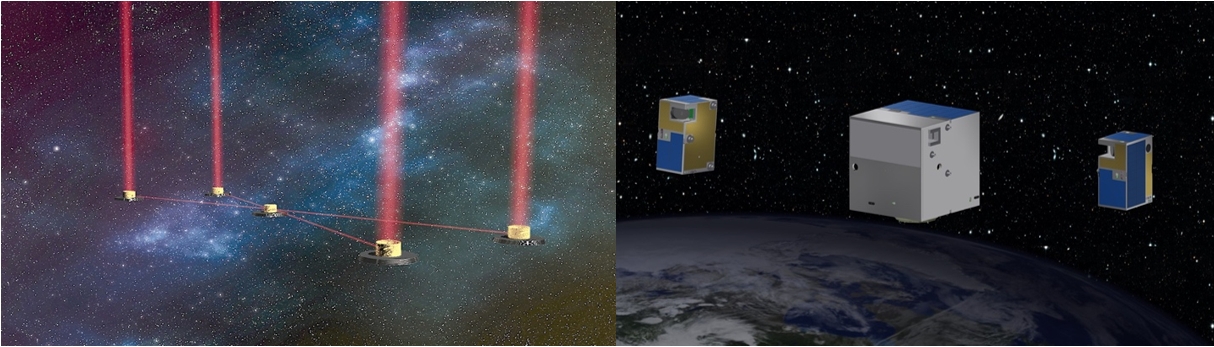 We develop coronagraphs for the direct observation of Earth like exoplanets and conduct demonstration observations using the Subaru Telescope. We also participate in various exploration missions aimed at investigating atmospheric surface environments, surrounding environments, and internal structures, including the search for habitable environments on icy bodies, and connect these activities to instrument development and observation proposals. Specifically, we are involved in the development of instruments and observation proposals for the Jupiter icy moons explorer "JUICE", which is en route to arrive at the Jovian system in 2031, the Titan lander "Dragonfly" and the ultraviolet space telescope "LAPYUTA", both targeting launches from the late 2020s to the early 2030s, as well as "SEIRIOS", the world's first space interferometer using formation flying of three nanosatellites.